
The computer that would not start
Alessandro Aimar’s first computer arrived at home in 1995, together with Windows 95. It would not switch on. His father proposed the sensible solution: take it back to the shop the following week. Alessandro, aged six, did not want to wait. He opened the case, dismantled what he could, understood almost nothing, put everything back together and pressed the button. The computer started.
It is a small episode, but it already reveals an essential part of his way of working. When something fails, his first instinct is not to look for a ready-made answer. It is to open the problem, examine its components and understand what is happening behind the interface. As a teenager, his passion for video games became programming. He wrote small pieces of software to automate tasks in online games while he was at school. By fourteen he already knew what it meant to trace a null pointer and search for the source of an error.
For a while he also considered journalism. He enjoyed writing, politics and international affairs. He chose physical engineering at the Polytechnic University of Turin instead: the place where curiosity about how things work could meet mathematics, electronics and semiconductors. The choice did not produce a straight path. When he finished his bachelor’s degree, the master’s programme he had intended to attend was discontinued. He had very little time to find another route.
He found it in a new international nanotechnology programme spanning Turin, Grenoble, Lausanne and a thesis abroad. What looked like a fallback permanently broke the geographical barrier.
Once you have learnt to move between university systems, languages and laboratories, going abroad stops being an exception and becomes the natural space in which to look for the next challenge.
Once the mental barrier between Italy and abroad disappears, it never comes back.
The difference between training and understanding
International experience made Alessandro appreciate something often taken for granted in Italy: the value of a strong theoretical education. He often met colleagues who were very good with a particular tool, but struggled as soon as they had to move to a new software release, or change a process or the context. The scarcity of resources in Italian universities, he argues, can paradoxically become a school of depth. If you cannot afford a new tape-out for every student’s thesis, you have to study more carefully what happens inside the circuit.
This is not a nostalgic defence of Italian academia. It is a sharper distinction between training and understanding. Knowing where to click speeds up a familiar task; knowing why the command works makes it possible to tackle an unfamiliar one. For Alessandro, that second ability would become decisive first in research and then in building Synthara.
A first attempt, and a lesson for the future
After his master’s degree, Alessandro immediately tried to found a startup. He had developed a technology as part of his master’s thesis and had the apparently simple idea of turning it into a product. But the friends with whom he hoped to build it quickly found jobs in the middle of the 2011 economic crisis and left him stranded. He was left with his idea, but no team. At twenty-four, he could not even define the business clearly enough to get it started.
Today he does not blame bad luck. “I was absolutely not ready,” he says. The project began with the wrong question: this technology is interesting; how can I sell it? It lacked a validated need, a value proposition, a customer and an understanding of the whole difference between a technical result that holds up and a company that works.
The failure did not extinguish his entrepreneurial ambition. It made it less naïve. Alessandro began to understand that technological quality is necessary but insufficient, and that a startup is not the automatic continuation of a thesis to which you attach a logo and a pitch deck.
Learning in the real world
His first job took him to Bristol and Imagination Technologies. The company designed PowerVR graphics architectures used, among other places, in Apple devices. For a young engineer it was a privileged viewpoint: advanced technology, complex processes, major customers and the pressure created when a semiconductor supplier has to answer to a company many times its size.
The internal culture left an impression. At Imagination Technologies, problems were not hidden behind corporate rhetoric. If a testbench was inadequate, people said so, because a flaw can only be fixed once it has been brought to light. Alessandro also learnt about the imbalance that can define the relationship between a supplier and a global customer. At times he found himself forced to help fix problems in circuits modified by the customer without being allowed to see the complete code. It was a practical lesson in ecosystems, negotiation and industrial dependency.
Within a few months Alessandro had risen through the company’s hierarchy and responsibilities, but the work soon stopped being stimulating enough. In practice, he could complete in a couple of weeks projects described as three-month assignments. Yet the issue was not the company’s ambition; it was rather his personal need to work closer to chip architecture, where he would not find himself, as was happening, dealing with problems created by others at a lower level of their definition.
A PhD without an instruction manual
Alessandro reached Zurich’s Institute of Neuroinformatics almost by chance. He was looking for a doctorate to return to research, and over time had considered quantum computing, photonics and even systems for nuclear fusion. A friend suggested a Swiss laboratory working on artificial intelligence and neuromorphic systems. He applied, was accepted and suddenly found himself immersed in a field about which he knew almost nothing, just months before AlphaGo brought artificial intelligence back to the attention of public debate.
The original Samsung-funded project was meant to focus on a neuromorphic chip. At the funder’s request it soon changed direction and became work on deep learning based on digital chips. The laboratory, however, specialised in analogue and neuromorphic electronics. So Alessandro spent four years teaching himself, for the most part, almost everything. When he had to estimate the circuit’s energy consumption and nobody had a suitable procedure, he would open the tool’s reference manual: roughly fifteen hundred pages to work through until the answer came out.
It is the same scene as the 1995 computer, on a different scale. There is no shop to which the problem can be delegated. There is no procedure to follow. There is a goal, an incomplete set of tools and the responsibility to find a solution.
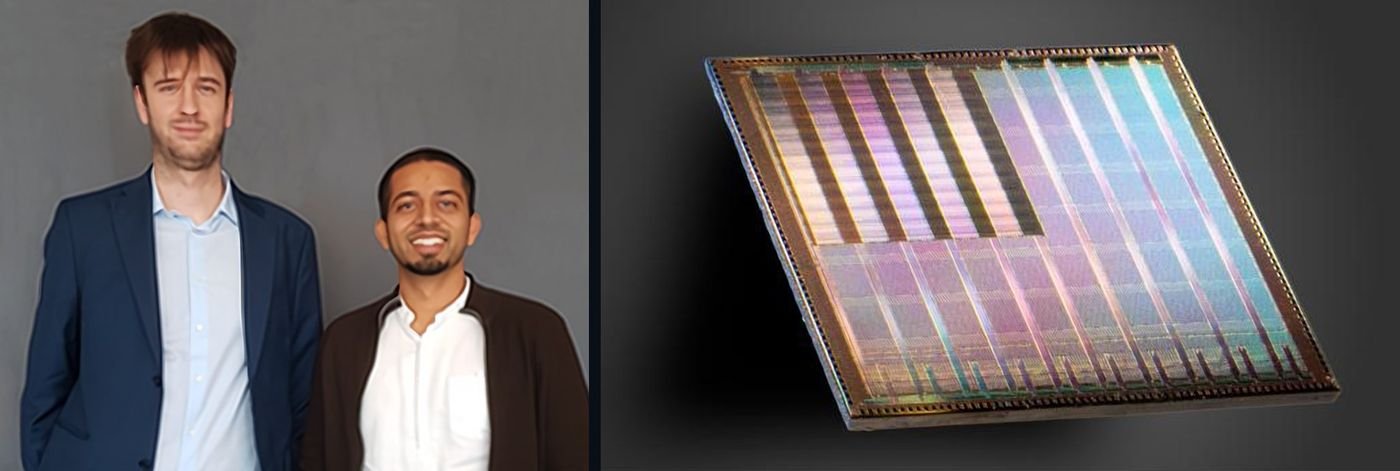
In that laboratory Alessandro met Manu V. Nair. They started their doctorates on the same day and, as often happens in research groups, collaboration began over lunch: daily conversations, hypotheses and company ideas.
Four years later, in 2019, they would found Synthara.
When there is nobody to ask, you open the manual and learn.
From research to Synthara
The first Synthara was not the company it is today. The project grew out of Alessandro’s research and aimed to build dedicated artificial-intelligence accelerators for edge applications. The team raised its first capital and developed multiple chip generations. The direction appeared clear, but in deep tech a roadmap rarely survives its encounter with markets, capital and competitors unchanged.
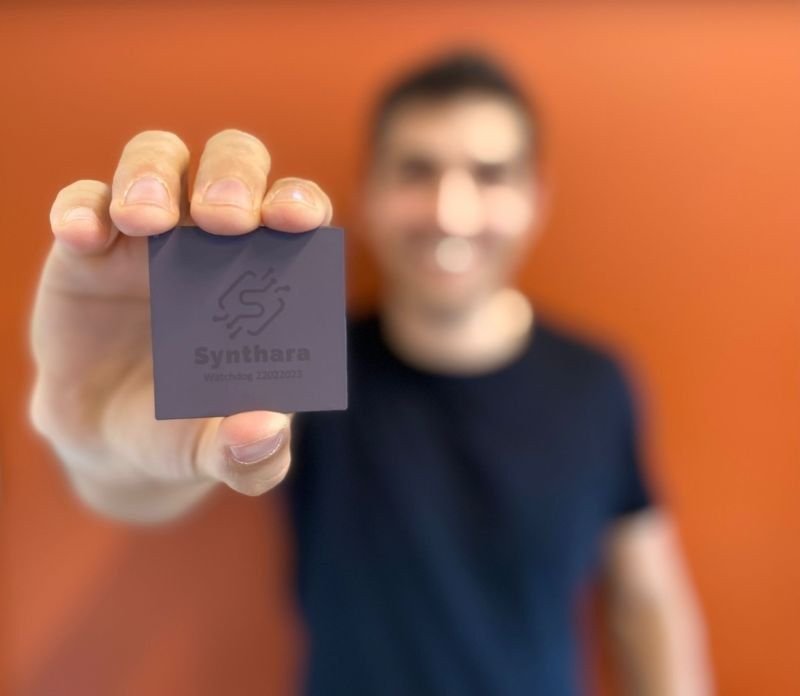
In 2022, the war in Ukraine caused an investor connected to Russian capital to disappear. For a company financing research, design and tape-outs, a failed round is not merely a delay. Synthara had to dismiss its first two employees, then call them back shortly afterwards because it had secured enough resources to keep them. The bank account went into overdraft. The CEO temporarily went without a salary. In the same period, Alessandro lost his father to cancer.
“We reached minus one day from bankruptcy,” he recalls. Not thirty days of runway: a point beyond the margin that usually precedes closure. Support from Excellis and other existing investors, followed by European and Swiss grants, gave the company oxygen and time to replan. It was a financial rescue, but more importantly it restored the ability to make decisions without every choice being dictated by the following week’s cash position.
That passage clarifies what patient capital means in deep tech. It is not simply accepting a longer timeline. It means distinguishing an unsolvable technical risk from a valid company hit by an external shock, and intervening while capital can still change the outcome.
A discussion at the whiteboard
Around the same time, several large companies presented accelerators with highly optimistic and commercially aggressive performance claims. Many of those promises would later be scaled back, but for a young startup with limited liquidity the signal was unmistakable: the positioning needed to be reconsidered.
Among the technologies developed by the team was an in-memory computing capability. During a discussion at the whiteboard, Alessandro almost incidentally suggested that this capability, part of the architecture they were developing, could be isolated, placed inside a CPU cache and turn memory into an active participant in computation. He did not present it as a product proposal. Manu, however, heard the remark and spent the following weeks working with the software team to test it. A few months later, he returned with an answer: yes, it could be done.
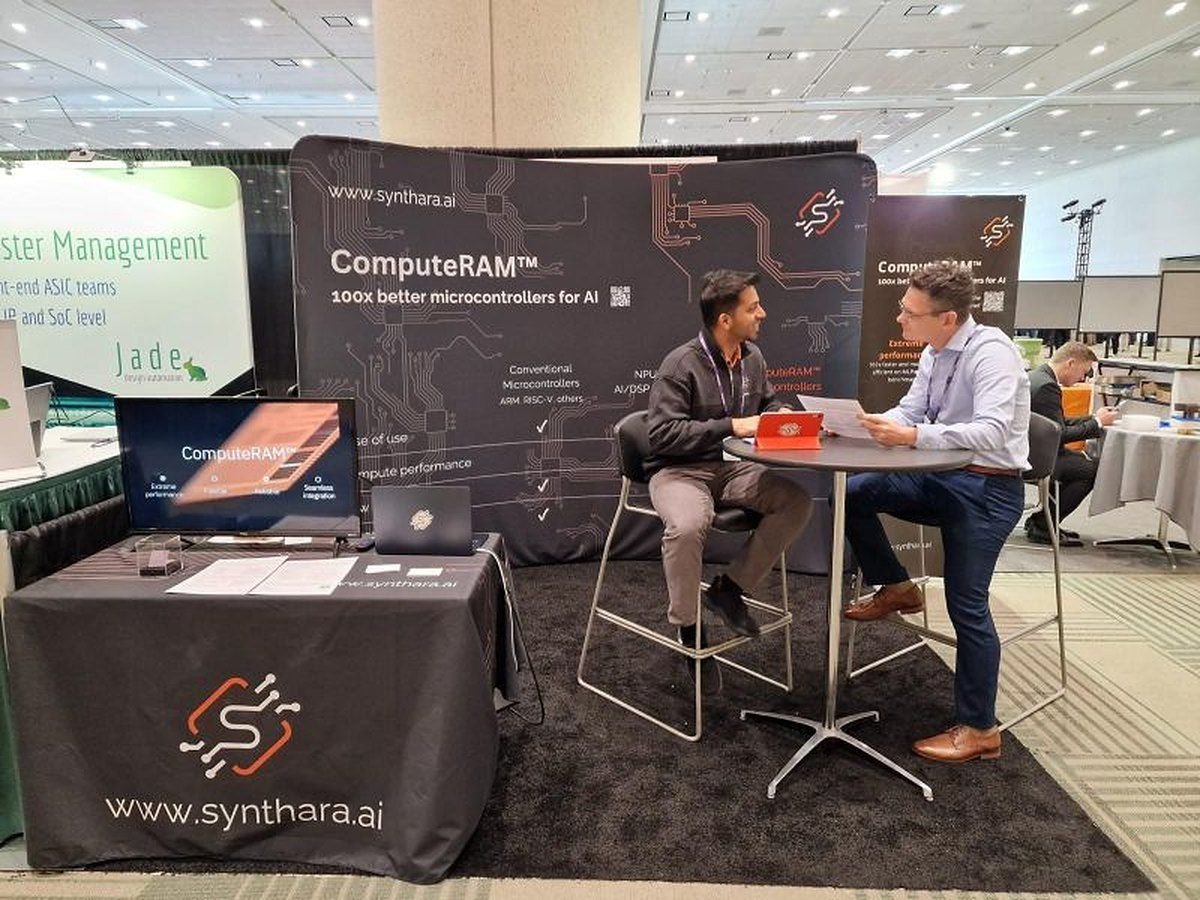
ComputeRAM grew from that observation. In conventional chips, data must continually travel between memory and compute units. In data-intensive applications such as AI and signal processing, that movement costs time and energy. ComputeRAM integrates computing capabilities directly into memory and is designed as a compatible replacement for SRAM, enabling designers to improve performance without rebuilding their whole system. Today Synthara can report gains of up to one hundred times in speed and energy efficiency on specific embedded workloads.
The strength of the pivot does not lie in abandoning the past. It lies in recognising, within work already completed, the element with the greatest potential to become a platform. If the idea emerged by chance, the ability to assess its potential did not. That required years of research, a team able to listen and to listen to one another, and the discipline to separate intuition from proof.
Between hardware and software
Synthara sells semiconductor intellectual property: a model familiar to specialists but less intuitive to many generalist investors. It is not a software company, yet it does not own a foundry or need to sell a chip of its own directly. It licenses technology blocks, models, tools and software that other manufacturers can integrate into their systems. ARM is the best-known reference, but naming it is not enough if the listener does not understand the economics of hardware IP.
This intermediate position is both an industrial advantage and a narrative difficulty. It requires less capital than direct chip production and can work across different architectures and processes. At the same time, it obliges the founders to explain repeatedly where value is created and how it is captured.
In 2024, Synthara announced more than $11 million in financing and grants to bring ComputeRAM to market. The company works with chipmakers, foundries and industrial partners, applying the technology to wearables, robotics, smart sensors and other systems in which latency and energy are decisive constraints. For Alessandro, the ambition extends beyond one product: to demonstrate that Europe can play a leading role in AI hardware.
Here emerges a contradiction we know well. Europe calls for digital sovereignty, but tends to be cautious about the very investments required to build it. An advanced chip can demand hundreds of millions, sometimes billions. Prudence protects the ecosystem from bubbles, but it can also exclude it from markets that offer no financial shortcuts. Synthara’s IP model is therefore an industrial choice and a realistic response to the structure of European capital.
Zurich: welcome without complete belonging
Zurich gave Synthara access to research, talent, responsive institutions and a cantonal bank whose mandate includes supporting the local economy, and which does so excellently. Alessandro nevertheless describes Switzerland without idealising it. The professional environment is international, but the worlds of foreigners and Swiss people often remain separate. Language — especially Swiss German — is a deeper barrier than it first appears.
It is possible to feel welcome without feeling that a place is completely yours. Institutions, he says, follow the company and ask how they can help even though neither founder is Swiss. Recognition comes through contribution: people enter the system by demonstrating that they create employment, technology and value. It is a concrete bargain, consistent with the experience of an engineer accustomed to judging things by how they work.
Go and hear “no”
At the end of my interview, Alessandro returns to his first startup attempt and draws from it his most direct piece of advice for founders at the start of their journey. He sees in many Italian founders a form of defensive perfectionism: months spent rewriting a slide, refining a detail and shielding the idea from other people’s judgement. Behind it lies a culture in which failure is not a setback along the way but a personal stigma. Fear of hearing “no” therefore produces slowness, if not immobility.
His alternative is simple and uncomfortable: expose the project early to the reality of the world. Go to an event even without a deck, explain the idea and listen to the objections. A fund that declines may explain why. After one hundred conversations, the one-hundred-and-first investor will see a proposition shaped by one hundred pieces of real feedback, rather than one hundred assumptions formed in isolation.
Go and let people tell you no. Then ask them why.
This is not an invitation to improvise. Alessandro’s story is built on study, rigour and technical depth. It is rather an invitation not to use preparation as a shelter from reality. Understanding what lies behind things lets us move when the context changes; putting them in front of the world tells us whether the problem we have chosen to tackle truly matters.
Synthara was born precisely at the intersection of those attitudes: a technology matured over years and called into question by an idea mentioned almost in passing at a whiteboard; a company that came close to shutting down and, precisely because of that, was able to redefine its product completely; a founder who, as a child, would not wait for somebody else to repair his computer and who now works to change the very way a computer performs its calculations.